
Dorchester County Projected and Actual Dates
A projected date is a calculation made before the release event. It may reflect the sentence, credit earned so far, and legal restrictions known at that point. An actual date is entered after the custodian completes a release or transfer. Those two dates may match, but they answer different questions.
For someone awaiting trial at L.C. Knight Dorchester County Detention Center, there is ordinarily no set sentence-release date. Bond may be posted, a court may change conditions, charges may be disposed of, another agency may lodge a hold, or processing may delay departure after a legal event. The Dorchester Public Index can show case events, but the online docket does not record the exact minute the jail releases a person.
A transfer is also not an actual community release. Someone can leave L.C. Knight for SCDC, another county, federal custody, or immigration custody. The county release entry should be read for the release type, destination, receiving agency, and detainer disposition if those fields are maintained and public.
How to Find a Dorchester County Release Date
The correct process follows the current custodian. Using an SCDC calculator for a county pretrial detainee can produce a false answer because no imposed state-prison term exists. Start with the person's present legal and custody status.
- Identify whether the person is at L.C. Knight, in SCDC, under another custodian, or already released. Confirm by name plus date of birth, booking number, SID, or SCDC number.
- For a pretrial county detainee, review the Dorchester court case for bond and later orders, then call L.C. Knight at 843-832-0215 for current custody confirmation.
- For a local jail sentence, obtain the sentencing order and jail-credit information from the court. Ask L.C. Knight for its calculated release record instead of applying the SCDC web calculator.
- For a current SCDC prisoner, use the ordinary SCDC public detail for the release-related field and current sentence data. Remember that it updates as of the previous midnight.
- When the calculation itself is disputed or unclear, contact SCDC Inmate Records at 803-896-8531 and provide the SCDC number.
- After release, verify the event through the SCDC Released Inmate Search or the Dorchester Sheriff's existing booking and release record.
The Dorchester County release search and records guide covers the wider identification path when it is unclear which system owns the record. A court sentence, jail calculation, VINE status, and SCDC record should be reconciled rather than treated as substitutes.
How SCDC Computes a Projected Release
An SCDC calculation starts with the imposed unsuspended term and sentence commencement date. It incorporates allowable jail credit and whether multiple terms run concurrently or consecutively. Staff then classify the offense under the law applicable at the time of offense and sentencing, apply mandatory-minimum or no-parole constraints, and account for credits the person is eligible to earn and has retained.
The order of those questions matters. Concurrent terms run together while consecutive terms run one after another. Jail credit may change the effective start point. An offense classification can limit early-release mechanisms. Credits cannot override a statutory floor. A detainer may prevent physical community release even when the South Carolina term reaches its calculated endpoint.
| Calculation input | Why it matters |
|---|---|
| Unsuspended term | Sets the sentence period actually imposed for service. |
| Commencement and jail credit | Determine when credited custody begins for the calculation. |
| Concurrent or consecutive terms | Controls whether sentence periods overlap or accumulate. |
| Offense classification and date | Determines which parole, no-parole, and credit rules apply. |
| Credits earned and retained | May reduce a date within statutory limits. |
| Detainers and later orders | May change the calculation or where the person goes next. |
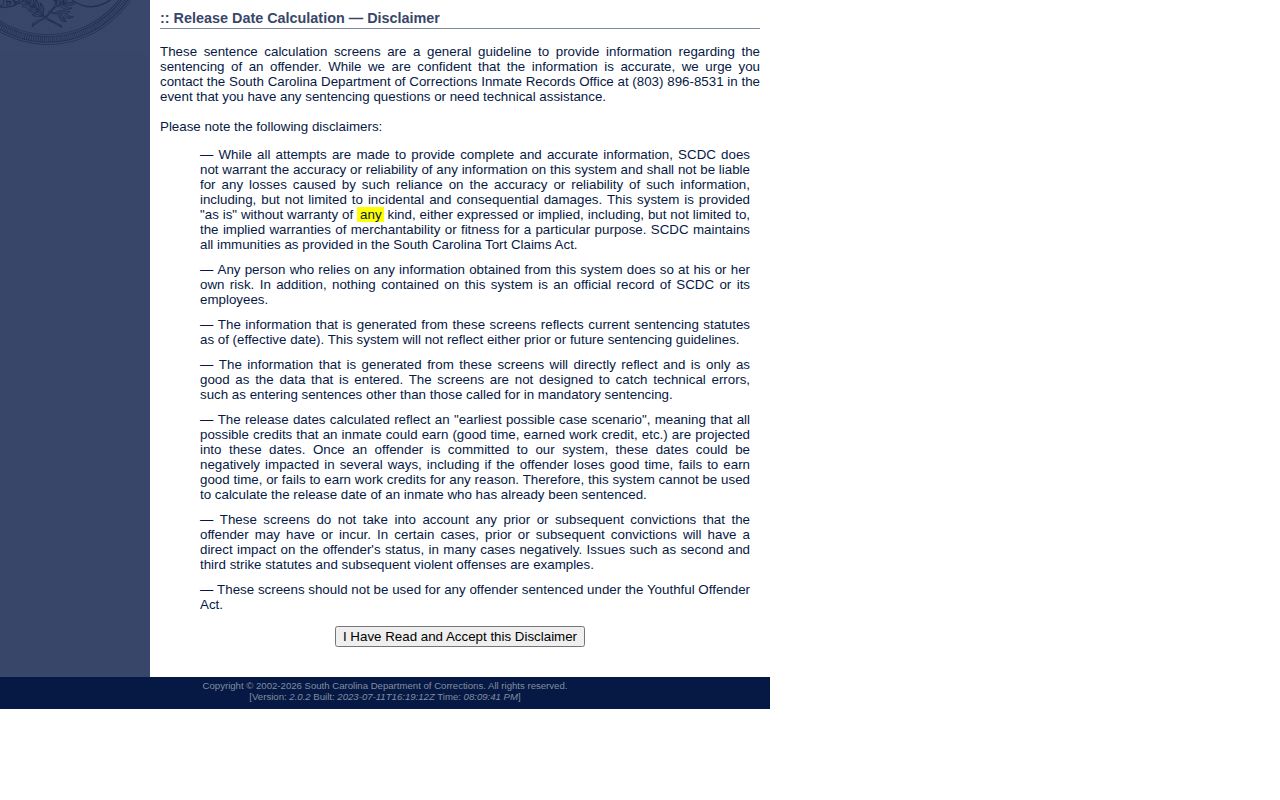
The public SCDC calculation tool calls its output an earliest-possible case scenario because it projects all possible credits. It expressly excludes a person already sentenced and Youthful Offender Act cases. The calculator is an explanation tool, not the official sentence record for a named prisoner.
South Carolina's 85 Percent Rule
South Carolina Code section 24-13-100 generally defines a no-parole offense as a Class A, B, or C felony or an exempt-from-classification offense punishable by a maximum term of 20 years or more. Section 24-13-150 then requires a person serving such an offense to complete at least 85 percent of the actual unsuspended term before early release, discharge, or the specified community-supervision stage.
Credits do not reduce that floor. This is why subtracting every theoretically available credit from the full sentence can produce a date that the law does not permit. The offense, sentence date, and exact judgment must be checked. A broad offense label or news description is not enough to classify the term.
The 85 percent requirement does not mean every South Carolina sentence uses one universal formula. Non-no-parole terms, mandatory minimums, consecutive cases, special statutes, and sentence corrections can all produce a different calculation. SCDC Inmate Records is the authoritative channel when the public detail and judgment do not reconcile.
Note: An 85 percent floor limits how far qualifying credits can move a no-parole sentence; it does not itself establish a person's calendar release date.
Good Conduct and Work or Education Credit
Section 24-13-210 provides eligible non-no-parole SCDC inmates a good-conduct deduction of 20 days for each month served. A no-parole inmate may receive three days per month, but those credits cannot breach the 85 percent minimum. Eligibility, retention, and the governing sentence remain part of the calculation.
Section 24-13-230 permits eligible non-no-parole inmates from zero to one day of reduction for every two days in productive duty or qualifying education, within statutory caps. It sets a smaller monthly framework for no-parole inmates, still subject to the statutory floor. Because the statute contains conditions and exclusions, a projected maximum should not be treated as credit already earned.
SCDC explains that good time can help establish sentence expiration but does not determine parole eligibility. Work and education credits can affect conditional or unconditional criteria as the law provides. Section 24-21-610 likewise says good-behavior deduction is not used to compute parole eligibility, while earned-work credits are deducted as specified.
- Good-conduct credit
- A statutory deduction for eligible behavior, subject to offense rules, forfeiture, and sentence limits.
- Earned work or education credit
- A separate reduction tied to eligible productive duty or qualifying education.
- Parole eligibility
- The first point at which the Board may consider a parolable case, not a promised release date.
- Sentence expiration
- The calculated end of a term after the rules and retained credits are applied.
Why a Dorchester Release Date Changes
A public date is a snapshot of a calculation. New information can move the date or change what happens at the endpoint. Even when the sentence math stays fixed, another agency's hold can change physical departure.
| Change | Effect on the release path |
|---|---|
| Disciplinary forfeiture | Loss of retained credit can move a projected date later. |
| Credit not earned | An earliest-case projection may no longer apply if work or education credit is not earned. |
| Corrected jail credit | A verified correction can move the calculation earlier or later. |
| Consecutive sentence or new conviction | Additional time may follow the term previously displayed. |
| Appeal or later court order | A legal change can alter the sentence basis. |
| Detainer or hold | The sentence may end, but the adult can transfer to another custodian. |
| Parole decision | A grant may permit conditional release; denial leaves the sentence calculation in place. |
A parole hearing or eligibility date is not a projected gate date. South Carolina's broad baseline under section 24-21-610 generally places violent-crime eligibility at one-third of the term or the mandatory minimum, whichever is longer, and other parolable crimes at one-fourth. Special long-term rules and exclusions apply, and many post-1995 no-parole offenses are ineligible.
The Board retains discretion. A grant may be conditional and later rescinded, and a posted hearing result does not show that prison release processing finished. After rejection, a future rehearing date marks another review opportunity, not the day the person will leave SCDC.
Dorchester County Jail Calculation Channel
L.C. Knight serves a different population and record system from SCDC. A person awaiting court action cannot be assigned a sentence expiration date merely from the booking charge. Bond, recognizance, dismissal, plea, sentencing, jail credit, and holds must be read from current official records.
For a local sentence, request the filed sentencing order from the correct Dorchester court and ask the jail for its calculated release record. The Sheriff's Office requires Detention Center public-record requests to use its online NextRequest portal. Identify the adult, booking number if known, and exact booking and release period. Ask for the existing record rather than asking staff to perform new legal calculations.
Useful existing fields may include booking date and time, charges, case and warrant numbers, bond, court, releasing facility, release date and time, release authority, release type or destination, transfer agency, and hold disposition. Not every field is necessarily public. Protected information may be redacted, and the agency does not have to create a record that does not exist.
Physical release can occur after the court event because staff still must verify authority, clear holds, close the booking, and process property or money acknowledgments. The court docket can explain why release became lawful, while the jail record establishes when county custody actually ended.
Reading the SCDC Release-Date Screens
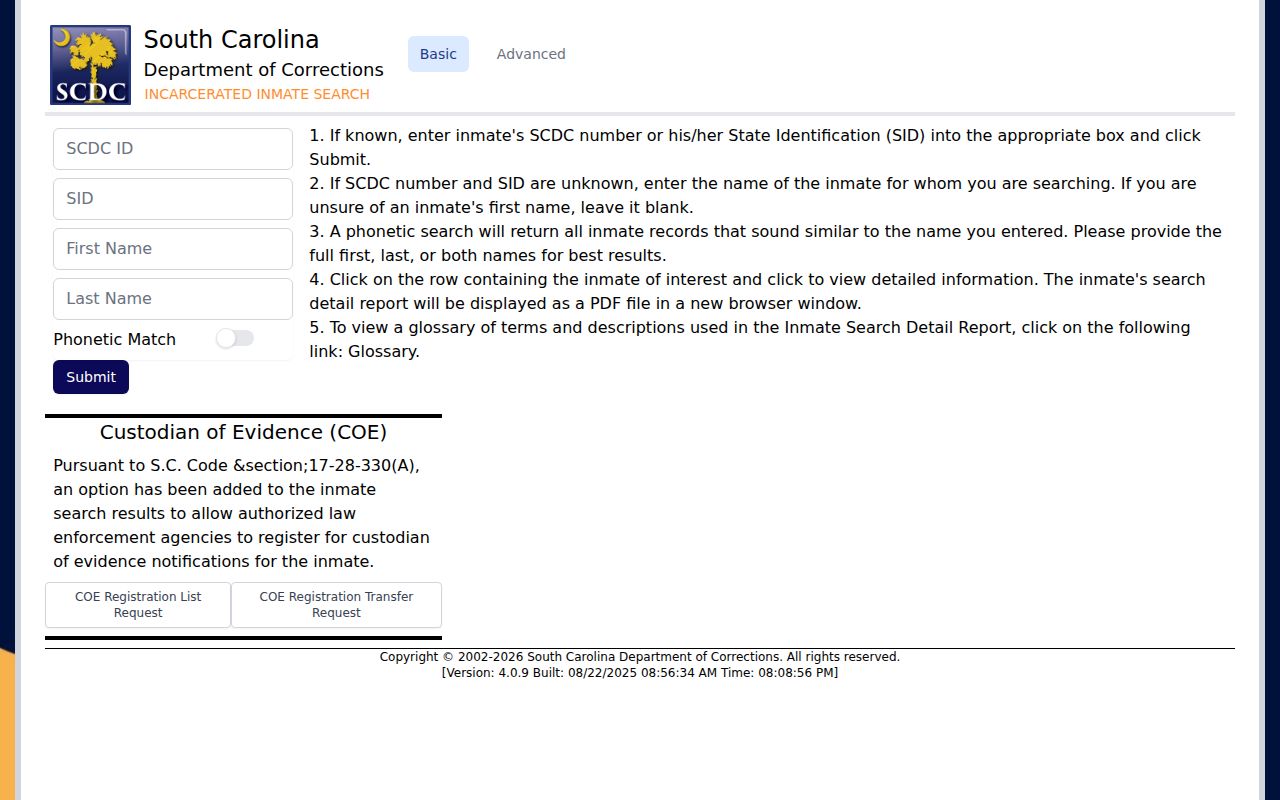
The ordinary SCDC search is designed for people currently sentenced to and incarcerated in SCDC as of midnight the previous day. A pending date displayed there is an estimate, not proof of completed release. Once a person is released, the regular search excludes that released or community-supervision record, so use the dedicated Released Inmate Search.
The official current-detail screenshot below shows the SCDC interface used to explain a pending release-related field. It must be read as a current custody record, not as historical proof that the release occurred.
The SCDC release calculator screenshot further explains that its result is an earliest-possible scenario and supplies the Inmate Records verification number. Its assumptions illustrate why an online estimate can differ from the official calculation.
After a completed state release, search by the released tool's date range and filters. Do not describe a Dorchester county filter as proof that release occurred from the county jail or from a prison physically located in Dorchester County. It is an SCDC search attribute, and the actual institution and record must be checked.
Confirming the Dorchester County Release Event
SC VINE can provide notice of a pending or completed custody change, but alerts can lag and do not replace the official historical record. Register on the correct agency record, retain the four-digit PIN for telephone notice, and re-register after transfer. The Dorchester County VINE inmate check gives the focused registration steps.
For a completed county event, use the L.C. Knight release record and the related court order. For a completed state event, use the SCDC Released Inmate Search and SCDC Inmate Records. If a record identifies another receiving custodian, confirm with that agency rather than calling the transfer a community release.
Keep the result precise: “projected,” “earliest possible,” “parole eligible,” “released from SCDC,” and “discharged from supervision” each describe a different point. The most reliable answer identifies the record owner, field label, date observed, and whether the event is forecast or complete.